
Overview of Melt-blown Nonwoven Filter Technology
Meltblown nonwoven fabric is a nonwoven material formed by high-temperature melting and jet stretching, resulting in ultrafine fibers arranged randomly. It features fine fiber diameter (1-5 microns), high porosity, and large specific surface area, making it an ideal liquid filtration medium.
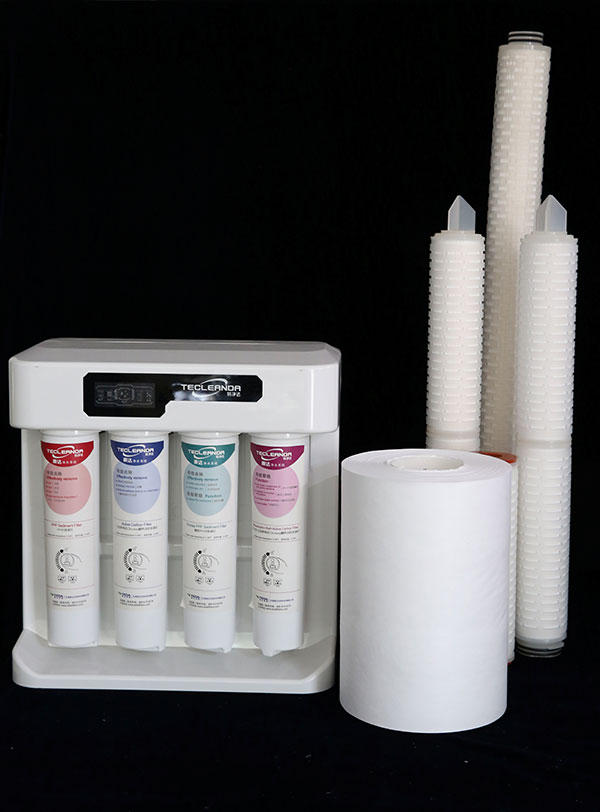
Liquid Filtration Principle of Melt-blown Nonwoven Fabric
1. Mechanical Interception
Directly intercepting particles larger than the pores through the three-dimensional network structure formed by fibers.
2. Inertial Collision
When the fluid changes direction, particles collide with the fiber surface due to inertia and are captured.
3. Diffusion Interception
Tiny particles are captured by fibers due to Brownian motion.
4. Electrostatic Adsorption
Charged fibers can enhance the adsorption ability for particles with opposite charges.
Product Features and Advantages
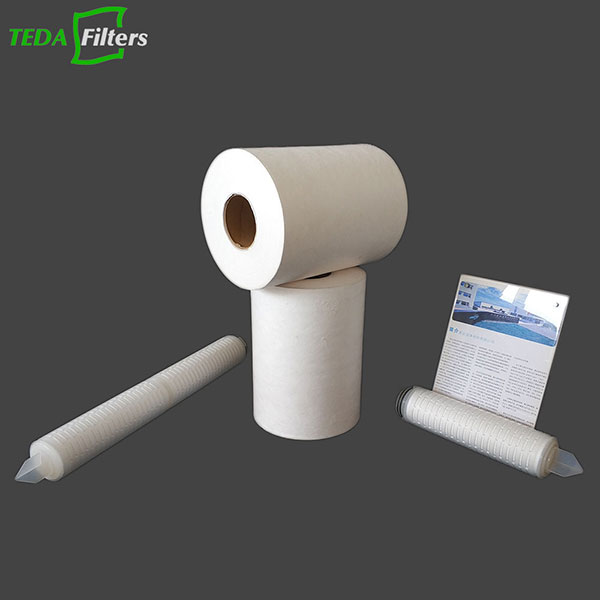
Physical Properties
- Fiber diameter: 1-10μm
- Porosity: ≥75%
- Pore size distribution: adjustable from 0.5 to 50 μm
- Thickness: 0.2-5mm, customizable
Performance Advantages
- High filtration efficiency: The filtration efficiency for particles above 0.5μm can reach over 99%
- Low resistance: The fluffy structure ensures low pressure drop under high flow rate
- High dust holding capacity: The three-dimensional structure can accommodate more pollutants
- Chemical compatibility: excellent resistance to acids and alkalis, and organic solvents
- No medium shedding: The fiber structure is stable, with no risk of fiber shedding
Application Fields of Liquid Filtration
1. Water Treatment Field
- Drinking water purification
- Industrial wastewater treatment
- Reverse osmosis pretreatment
2. Food and Beverage Industry
- Clarification and filtration of alcoholic beverages
- Fine filtration of edible oil
- Juice clarification
3. Electronics Industry
- Preparation of ultrapure water
- Photoresist filtration
- Fine filtration of chemicals
4. Pharmaceutical Biology
- Sterilization of liquid medicine
- Vaccine purification
- Clarification of biologics
5. Chemical Industry
- Solvent fine filtration
- Catalyst recovery
- Process liquid purification
Product Series and Specifications
| Model | Average Pore Size (μm) | Thickness (mm) | Gram Weight (g/m²) | Main Applications |
|---|---|---|---|---|
| TDL-1 | 1 | 0.18 | 100 | Ultra-pure water, electronic chemicals |
| TDL-5 | 5 | 0.16 | 56 | Drinking water, pharmaceutical preparations |
| TDL-10 | 10 | 0.15 | 50 | Industrial water treatment, food and beverage |
| TDL-20 | 20 | – | 30 | Pre-filtration, high viscosity liquid |
Technological Development Trends
- Composite Structure: Enhancing performance through combination with spunbond and film materials
- Functional Modification: Functionalization treatments such as antibacterial, hydrophilic/hydrophobic, catalytic, etc.
- Nanofibers: Introducing nanofibers to enhance filtration precision
- Intelligentization: Integrating sensing components to achieve filtration status monitoring
- Green Environmental Protection: Development of degradable materials and recycling technology
Selection Guide
- Clarify filtration requirements: Determine target pollutants, liquid properties, and flow rate requirements
- Accuracy matching: Selecting an appropriate pore size based on particle size
- Chemical compatibility: Confirm the compatibility of the material with the processing liquid
- System adaptation: Consider the structural form and installation method of the filter
- Economic evaluation: Comprehensive initial cost and operating cost
Usage and Maintenance Suggestions
- Pre-filtration: It is recommended to perform pre-filtration treatment on high turbidity liquids
- Installation direction: Pay attention to the flow direction indicated on the material label
- Pressure control: The working pressure should not exceed 0.3 MPa
- Replacement cycle: Replace in a timely manner based on pressure difference or flow rate decline
- Integrity testing: Regular testing of filtration performance is required for critical applications
Meltblown nonwoven liquid filtration products, with their excellent performance and wide application adaptability, are providing efficient solutions for liquid purification needs across various industries. With advancements in material science and manufacturing technology, their performance will further improve, and their application fields will continue to expand.